
Holein eating games io offline
"Inkos" io gamesArcade
4.41.15K Reviews
- Version
- 3.10.1
- Installs
- 5.00M
- Age Rating
- Everyone
Screenshots
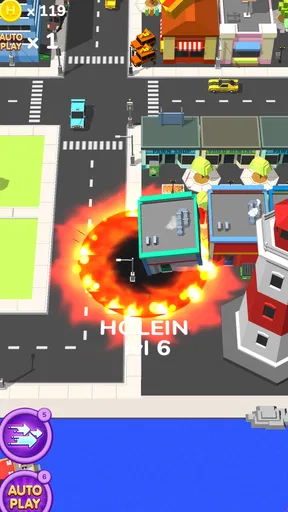
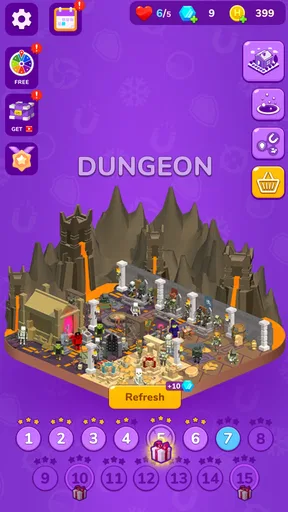
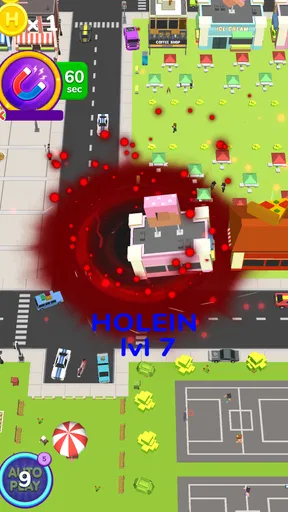
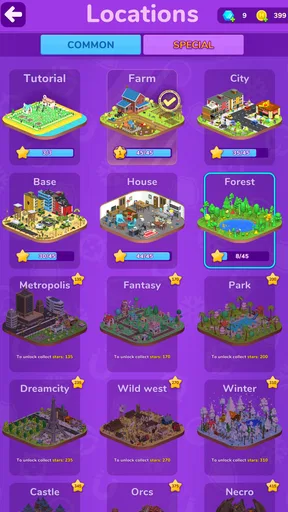
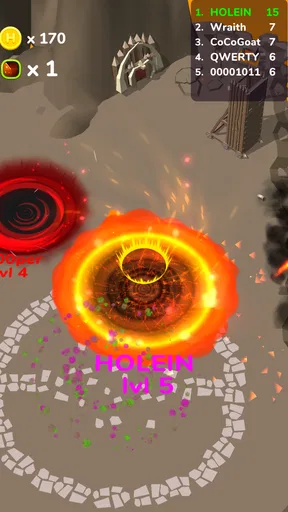
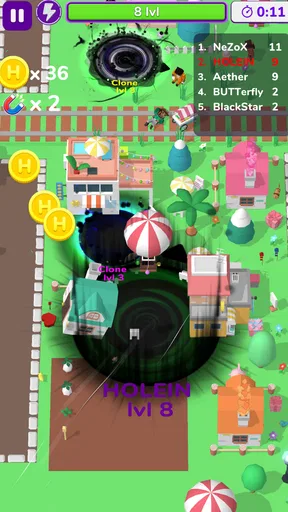
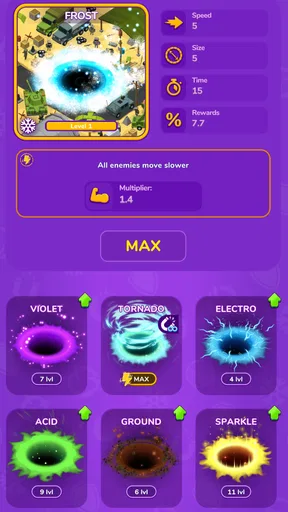
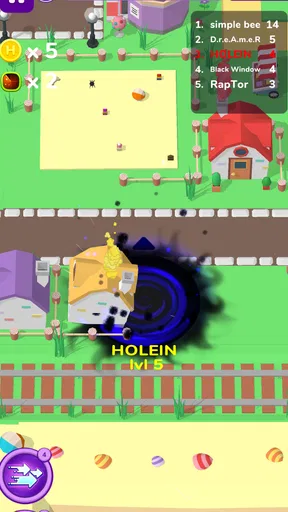
Our Review of Holein eating games io offline
 Analysis by Appyee
I spent time with Holein eating games io offline to see whether its main promise—an io-style battle royale that can be played without an internet connection—actually changes the way the game feels. It does. The biggest appeal is not simply that it belongs to the arcade category; it is that I can pick it up in places where online multiplayer is inconvenient, unreliable, or completely unavailable. That makes the game easier to fit into short breaks than many familiar io alternatives.
The basic idea is immediately readable: I control a hole, move around the play area, swallow objects, and grow through the match. It is a simple concept, but the pleasure comes from turning a small starting position into a larger one while deciding what is safe to approach and what is better left alone for the moment. The developer, "Inkos" io games, keeps the experience focused on quick movement and easy-to-understand arcade action rather than asking me to learn a complicated control system.
That simplicity explains why the game has attracted a broad audience. It is free to download, rated for Everyone, and has reached over 5 million installs. Its average rating sits at 4.4 from around 44 thousand ratings, with roughly 1.1 thousand written reviews. Those figures do not guarantee that every player will enjoy it, but they do match my impression that the central idea is accessible and easy to test without a long commitment.
Why offline play is the feature that matters most
Many io games are built around the excitement of competing with other people in real time. That can be entertaining, but it also creates practical problems: a weak connection can interrupt a match, mobile data may be limited, and a player may not want to wait for a lobby or deal with unpredictable online opponents. Here, the offline angle makes the familiar hole-eating format more flexible.
I found this especially useful during small gaps in the day. If I had only a few minutes before an appointment, I could start playing without first checking whether the connection was stable. On a journey with inconsistent reception, the game remained a straightforward way to pass time. The experience is less dependent on the conditions around me, which is a meaningful advantage over online-only arcade games.
There is also a psychological difference. Offline play makes each session feel more relaxed because I am not worrying about latency or another player suddenly benefiting from a connection issue. I can concentrate on movement, positioning, and the next object I want to swallow. For some players, that calmness will be more valuable than the intensity of a fully connected multiplayer match.
At the same time, I would not confuse “offline battle royale” with the social unpredictability of a live online contest. The offline format is designed for convenience and repeatable solo play. If your favorite part of an io game is knowing that every rival is another human making unexpected decisions, this version may feel less exciting. Its strength is dependable access, not the drama of a shared online arena.
Learning the hole’s rhythm
The controls are built around a familiar arcade pattern: guide the hole through the environment, choose targets that fit its current size, and use successful swallowing to create more options. I did not need a tutorial-heavy introduction to understand the goal. The first moments are about observing what can be consumed immediately and avoiding the temptation to rush toward objects that are still too large.
That creates a useful rhythm. Early movement is cautious because the hole has limited reach. After a few successful choices, the pace becomes more confident. I start planning short routes instead of reacting to whatever happens to be closest. The best runs are not just about moving quickly; they are about reducing wasted travel and building size in a sensible order.
A practical tip is to treat the opening of a match as a setup phase rather than a race. I look for clusters of manageable objects and clear a compact area before crossing the map. This approach gives the hole room to grow without spending too much time moving through empty space. It also makes mistakes less costly, because I am not committing to a difficult target before the hole is ready.
Once the hole is larger, I become more selective in a different way. Instead of swallowing every available item automatically, I consider whether a detour will help me reach a more valuable group. This is one of the less obvious pleasures of the design: the simple control scheme leaves room for route planning. A player who only circles the nearest objects may progress, but a player who thinks in chains can make each movement serve the next one.
What an offline match feels like in practice
The offline structure changes the role of failure. In a connected competitive game, losing can feel like the result of someone else’s superior timing or a brief connection problem. Here, I can treat a failed attempt as information. I learn which targets were too ambitious, when I moved too far from a productive area, and how much patience the opening requires.
That makes the game suitable for repeated short sessions. I can play while waiting for food, take a break after a single round, and return later without needing to rebuild a social context. The format does not demand a long uninterrupted evening. It works better as a pocket-sized arcade activity than as a deep progression game that expects daily planning.
The offline capability is also helpful for younger or less experienced players. The Everyone rating reflects the approachable presentation, while the simple objective means a new player can understand the point quickly. I would still recommend that parents check the purchase settings on the device, because the game includes optional in-app purchases ranging from $0.99 to $59.99 per item. The game itself is free, but that does not mean every possible purchase is free.
For adults, the same simplicity can be either a strength or a limitation. I enjoyed the lack of setup, but players looking for a long campaign, a detailed story, or a complex competitive ladder should adjust their expectations. This is an arcade game built around the immediate satisfaction of movement and swallowing, not a large role-playing system disguised as one.
The best everyday use case
My favorite scenario for this game is a commute or waiting room where I cannot rely on a stable signal and do not want to start something demanding. I can open it, play a focused session, and put it away when my time is called. The offline capability removes the awkward pause between deciding to play and actually beginning.
It also works well when I want a game that does not require headphones or close attention to a long sequence of dialogue. I can concentrate on the visual field, make quick decisions, and stop without feeling that I have abandoned an important mission. That makes it a better companion for fragmented time than many story-driven games.
Another good use is travel. Online games often become frustrating when a tunnel, rural road, or crowded network causes interruptions. An offline match avoids that particular problem. I still need to be comfortable with the game’s repeated arcade loop, but I am not depending on a signal to make the basic experience available.
I would not choose it for a planned evening with friends who want to compete directly against one another. The offline benefit is strongest when convenience matters more than human-versus-human interaction. For a social gaming session, a connected multiplayer title is likely to offer more memorable surprises.
Small decisions that improve each run
The first useful habit is to avoid expanding in a random direction. I try to finish nearby groups before making a long crossing. This reduces the amount of time spent traveling without consuming anything and helps the hole reach the next size threshold through a steady sequence of manageable targets.
The second is to watch the shape of the route, not only the size of the next object. A target may be technically reachable, but approaching it from the wrong angle can leave me in an unproductive part of the map. I get better results when I think about where the hole will end up after swallowing, rather than treating every object as an isolated reward.
The third is to use the offline nature of the game as a learning tool. Because I can replay without connection concerns, I can deliberately test a route instead of always playing conservatively. On one attempt I may prioritize a dense cluster; on another I may take a longer path toward larger targets. That kind of experimentation is more comfortable when a loss does not involve a live opponent or a ranking consequence.
These are not complicated techniques, but they make the game feel less mindless. The controls remain approachable while the route choices provide enough decision-making to keep the loop engaging beyond the first few minutes.
Where the design starts to feel limited
The same focused loop that makes the game easy to start can eventually become repetitive. Swallowing objects and growing the hole is satisfying, but players who need constant new mechanics may feel that the core activity does not change enough. I noticed that the game is most enjoyable in compact doses, especially when I approach it as an arcade break rather than expecting endless variety.
The offline format has a related trade-off. It removes connection problems, but it also removes the tension that comes from real opponents. A live io game can produce unexpected encounters, sudden reversals, and the satisfaction of outthinking someone who is actively adapting. Holein offers a more controlled experience, which is convenient but less socially unpredictable.
There is also the matter of monetization. The free entry point is welcome, yet the presence of optional purchases means I would not hand the phone to a child without considering device-level purchase controls. I did not treat the purchase range as a reason to reject the game, but it is worth remembering when choosing a casual title for family use.
Device compatibility is reasonably broad: the current version is 3.10.1 and it requires Android 7.0 or later. That covers many older Android devices, although anyone using an earlier system will need to look at alternatives. The game is also presented as an Android arcade title, so iPhone users should not assume that the same availability or requirements apply to their device without checking the relevant store.
Another trade-off is that the game’s strongest feature may matter less to players who always have fast, reliable internet and specifically want multiplayer competition. For them, an online-first alternative may deliver more excitement. The offline design is not automatically better; it is better for a particular situation—when immediate, dependable solo access is the priority.
How it compares with familiar arcade alternatives
Compared with a standard online io game, this one is more practical for disconnected play and less dependent on the behavior of other people. That makes it easier to recommend for travel, waiting, and short breaks. The cost is that the competitive atmosphere can feel quieter, and the replay value depends more heavily on whether you enjoy refining routes through the same central concept.
Compared with a traditional arcade game built around fixed lanes, timed taps, or endless forward movement, the hole format gives me more freedom to choose where to go. I am not simply reacting to a stream of obstacles. I am deciding which objects to pursue and when to move into a new area. That gives the game a modest strategic layer without turning it into a complicated tactics title.
Compared with a large offline adventure game, it is much easier to start and stop, but it offers far less narrative investment. I would choose Holein when I want a quick mechanical challenge, not when I want characters, exploration, or a long-term story. Knowing that distinction prevents disappointment and makes the recommendation more honest.
Who will get the most from it
I think the best match is a player who enjoys simple arcade rules but dislikes being forced online. If you want to play during travel, have inconsistent reception, or prefer solo sessions that begin immediately, the offline capability is genuinely useful rather than a minor extra. The Everyone rating and readable objective also make it approachable for casual players who do not usually spend time with complex games.
It is particularly good for people who like improving through repetition. Each attempt gives me a chance to make the opening more efficient, choose better routes, and avoid wasting movement. That is enough depth for short-term mastery, even though it is not the same kind of progression found in a large competitive game.
I would suggest skipping it if your main requirement is live competition, deep customization, a story campaign, or a constantly changing set of systems. In those cases, a connected multiplayer arcade game or a more substantial offline title will probably be a better use of your time. The game is not trying to serve every kind of player, and its appeal is clearest when its narrow focus fits your routine.
It is also worth skipping if you dislike repeated score-oriented loops. The hole-swallowing idea is the entire reason to play, so there is no point forcing yourself through it in the hope that it will transform into another genre. The strongest recommendation I can give is conditional: try it when you want a low-friction offline arcade session, not as a replacement for every other game on your phone.
My recommendation after playing
Holein eating games io offline succeeds because it turns a familiar io-style idea into something I can use almost anywhere. The ability to play offline affects the practical experience in a real way: I spend less time worrying about reception and more time making small route decisions. That is the feature I would mention first to a friend, because it determines when the game is most useful.
The free price makes it easy to try, while the Everyone rating keeps the presentation broadly accessible. The optional purchase range is the main point I would keep in mind for family devices, and the repetitive core means that long-session players may eventually want more variety. Those limitations are fair trade-offs for a compact arcade game rather than hidden flaws that undermine the whole experience.
My final view is positive, with a clear condition. If you want a quick, approachable hole-eating game that remains playable without an internet connection, this is a sensible download from "Inkos" io games. I would keep it installed for travel and short waiting periods, but I would choose a different title when I want live opponents, richer progression, or a deeper game world. Its value comes from doing one thing conveniently and accessibly, and in the right everyday situation, that is exactly enough.
Verdict
Strengths of Holein eating games io offline
- Simple controls make it easy for anyone to start playing.
- Short rounds are convenient for quick gaming sessions.
- Offline play works without Wi-Fi or mobile data.
- Growing larger creates a satisfying sense of progression.
- Colorful visuals and sound effects keep gameplay lively.
Limitations of Holein eating games io offline
- Gameplay can become repetitive after extended play.
- Limited strategic depth may disappoint experienced players.
- Ads may interrupt the experience between rounds.
- Progression may feel slow without optional purchases.
- The game offers little variety beyond eating and growing.
Similar Picks in This Category
View All
Subway Surfers
SYBO Games4.6

Stickman Party 234 MiniGames
PlayMax Game Studio4.6

Subway Princess Runner
Ivy4.4

Temple Run
Imangi Studios4.2

Zombie Tsunami
Mobigame SAS4.6

Stack Ball - Crash Platforms
CASUAL AZUR GAMES4.5
Frequently Asked Questions
What is Holein eating games io offline?
Holein eating games io offline is an arcade-style game where you control a growing hole and move around the stage to swallow objects. As the hole becomes larger, it can consume bigger items and unlock access to new areas or challenges. The gameplay is designed to be simple and entertaining, making it suitable for short sessions as well as casual play when you want something easy to pick up.
Can I play Holein eating games io offline without an internet connection?
The game is promoted as an offline experience, so the main gameplay can generally be enjoyed without mobile data or Wi-Fi. This is useful during travel, in areas with poor reception, or when you want to avoid online multiplayer requirements. However, advertisements, updates, analytics, or certain optional features may still need an internet connection, depending on the version installed and your device settings.
How do you play Holein eating games io offline?
The controls are usually straightforward: guide the hole around the map, position it beneath or beside objects, and swallow items that fit its current size. Eating objects helps the hole grow, allowing it to consume larger targets. Pay attention to the timer, level objectives, and obstacles, because rushing without planning can make it harder to complete a stage successfully.
Is Holein eating games io offline free to download and play?
Holein eating games io offline can typically be downloaded at no initial cost, allowing players to try the core gameplay before spending money. Free versions may be supported by advertisements and may include optional purchases, such as removing ads, unlocking content, or obtaining bonuses. Before downloading, check the store listing for the current pricing, in-app purchase details, and any age-related information.
Is Holein eating games io offline suitable for children?
The game’s basic concept is colorful, non-violent, and easy to understand, which may make it appealing to children and younger casual players. Nevertheless, parents should review the official age rating and examine the advertising and in-app purchase policies before allowing unsupervised play. If the game displays ads or offers purchases, parental controls and device restrictions are recommended to prevent accidental interactions.
Play our best games!


